static int __init_memblock memblock_add_range(struct memblock_type *type,
    phys_addr_t base, phys_addr_t size,
    int nid, enum memblock_flags flags)
{
    bool insert = false;
    phys_addr_t obase = base;
    phys_addr_t end = base + memblock_cap_size(base, &size);
    int idx, nr_new, start_rgn = -1, end_rgn;
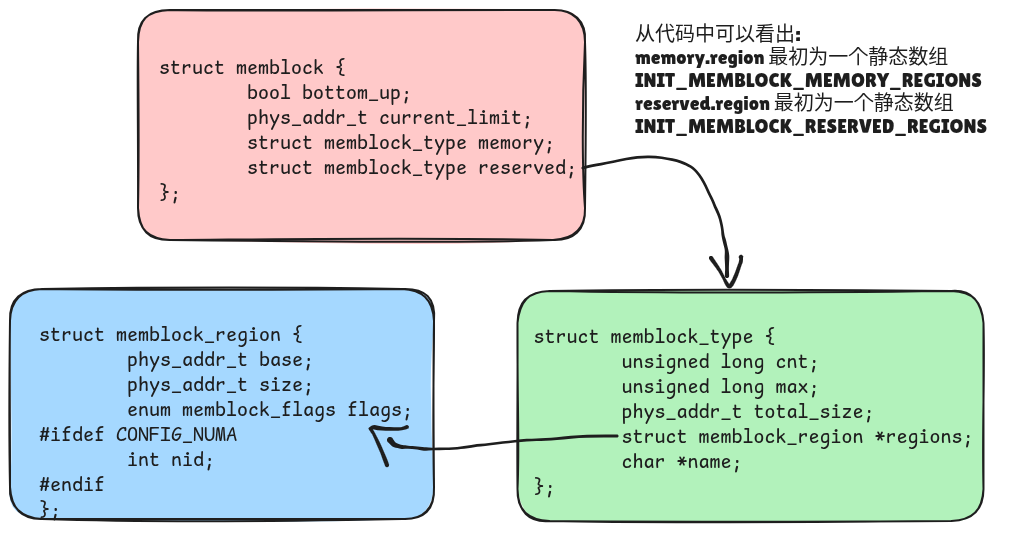
    struct memblock_region *rgn;

    if (!size)
        return 0;

    /* special case for empty array */
    if (type->regions[0].size == 0) {
        WARN_ON(type->cnt != 0 || type->total_size);
        type->regions[0].base = base;
        type->regions[0].size = size;
        type->regions[0].flags = flags;
        memblock_set_region_node(&type->regions[0], nid);
        type->total_size = size;
        type->cnt = 1;
        return 0;
    }

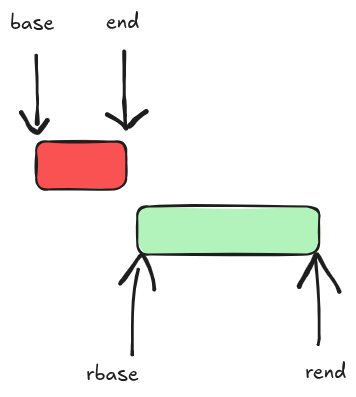
    /*
    * The worst case is when new range overlaps all existing regions,
    * then we'll need type->cnt + 1 empty regions in @type. So if
    * type->cnt * 2 + 1 is less than or equal to type->max, we know
    * that there is enough empty regions in @type, and we can insert
    * regions directly.
    */
    if (type->cnt * 2 + 1 <= type->max)
        insert = true;

repeat:
    /*
    * The following is executed twice.  Once with %false @insert and
    * then with %true.  The first counts the number of regions needed
    * to accommodate the new area.  The second actually inserts them.
    */
    base = obase;
    nr_new = 0;

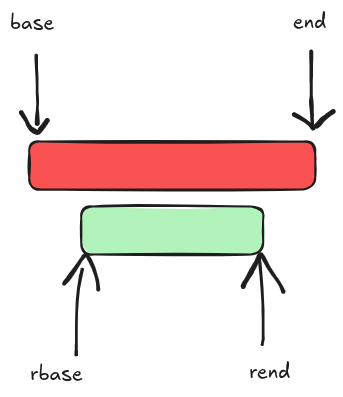
    for_each_memblock_type(idx, type, rgn) {
        phys_addr_t rbase = rgn->base;
        phys_addr_t rend = rbase + rgn->size;

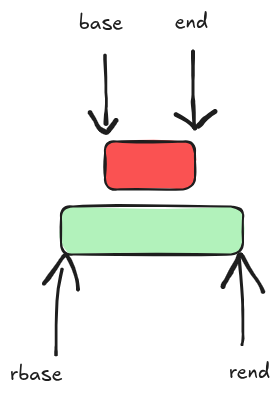
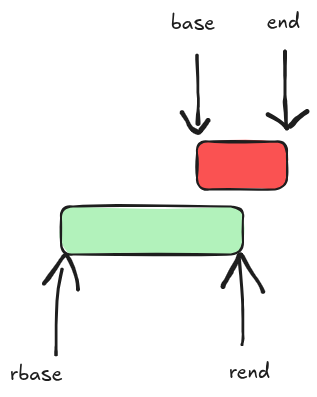
        if (rbase >= end)
            break;
        if (rend <= base)
            continue;
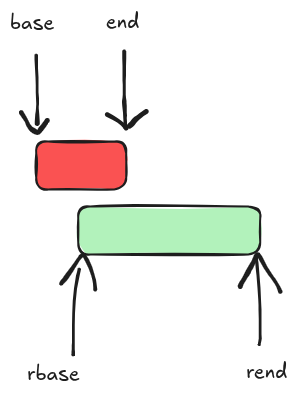
        /*
        * @rgn overlaps.  If it separates the lower part of new
        * area, insert that portion.
        */
        if (rbase > base) {
#ifdef CONFIG_NUMA
            WARN_ON(nid != memblock_get_region_node(rgn));
#endif
            WARN_ON(flags != MEMBLOCK_NONE && flags != rgn->flags);
            nr_new++;
            if (insert) {
                if (start_rgn == -1)
                    start_rgn = idx;
                end_rgn = idx + 1;
                memblock_insert_region(type, idx++, base,
                            rbase - base, nid,
                            flags);
            }
        }
        /* area below @rend is dealt with, forget about it */
        base = min(rend, end);
    }
    bool insert = false;
    phys_addr_t obase = base;
    phys_addr_t end = base + memblock_cap_size(base, &size);
    int idx, nr_new, start_rgn = -1, end_rgn;
    struct memblock_region *rgn;

    if (!size)
        return 0;

    /* special case for empty array */
    if (type->regions[0].size == 0) {
        WARN_ON(type->cnt != 0 || type->total_size);
        type->regions[0].base = base;
        type->regions[0].size = size;
        type->regions[0].flags = flags;
        memblock_set_region_node(&type->regions[0], nid);
        type->total_size = size;
        type->cnt = 1;
        return 0;
    }

    /*
    * The worst case is when new range overlaps all existing regions,
    * then we'll need type->cnt + 1 empty regions in @type. So if
    * type->cnt * 2 + 1 is less than or equal to type->max, we know
    * that there is enough empty regions in @type, and we can insert
    * regions directly.
    */
    if (type->cnt * 2 + 1 <= type->max)
        insert = true;

repeat:
    /*
    * The following is executed twice.  Once with %false @insert and
    * then with %true.  The first counts the number of regions needed
    * to accommodate the new area.  The second actually inserts them.
    */
    base = obase;
    nr_new = 0;

    for_each_memblock_type(idx, type, rgn) {
        phys_addr_t rbase = rgn->base;
        phys_addr_t rend = rbase + rgn->size;

        if (rbase >= end)
            break;
        if (rend <= base)
            continue;
        /*
        * @rgn overlaps.  If it separates the lower part of new
        * area, insert that portion.
        */
        if (rbase > base) {
#ifdef CONFIG_NUMA
            WARN_ON(nid != memblock_get_region_node(rgn));
#endif
            WARN_ON(flags != MEMBLOCK_NONE && flags != rgn->flags);
            nr_new++;
            if (insert) {
                if (start_rgn == -1)
                    start_rgn = idx;
                end_rgn = idx + 1;
                memblock_insert_region(type, idx++, base,
                            rbase - base, nid,
                            flags);
            }
        }
        /* area below @rend is dealt with, forget about it */
        base = min(rend, end);
    }

    /* insert the remaining portion */
    if (base < end) {
        nr_new++;
        if (insert) {
            if (start_rgn == -1)
                start_rgn = idx;
            end_rgn = idx + 1;
            memblock_insert_region(type, idx, base, end - base,
                        nid, flags);
        }
    }

    if (!nr_new)
        return 0;

    /*
    * If this was the first round, resize array and repeat for actual
    * insertions; otherwise, merge and return.
    */
    if (!insert) {
        while (type->cnt + nr_new > type->max)
            if (memblock_double_array(type, obase, size) < 0)
                return -ENOMEM;
        insert = true;
        goto repeat;
    } else {
        memblock_merge_regions(type, start_rgn, end_rgn);
        return 0;
    }
}

    /* insert the remaining portion */
    if (base < end) {
        nr_new++;
        if (insert) {
            if (start_rgn == -1)
                start_rgn = idx;
            end_rgn = idx + 1;
            memblock_insert_region(type, idx, base, end - base,
                        nid, flags);
        }
    }

    if (!nr_new)
        return 0;

    /*
    * If this was the first round, resize array and repeat for actual
    * insertions; otherwise, merge and return.
    */
    if (!insert) {
        while (type->cnt + nr_new > type->max)
            if (memblock_double_array(type, obase, size) < 0)
                return -ENOMEM;
        insert = true;
        goto repeat;
    } else {
        memblock_merge_regions(type, start_rgn, end_rgn);
        return 0;
    }
}
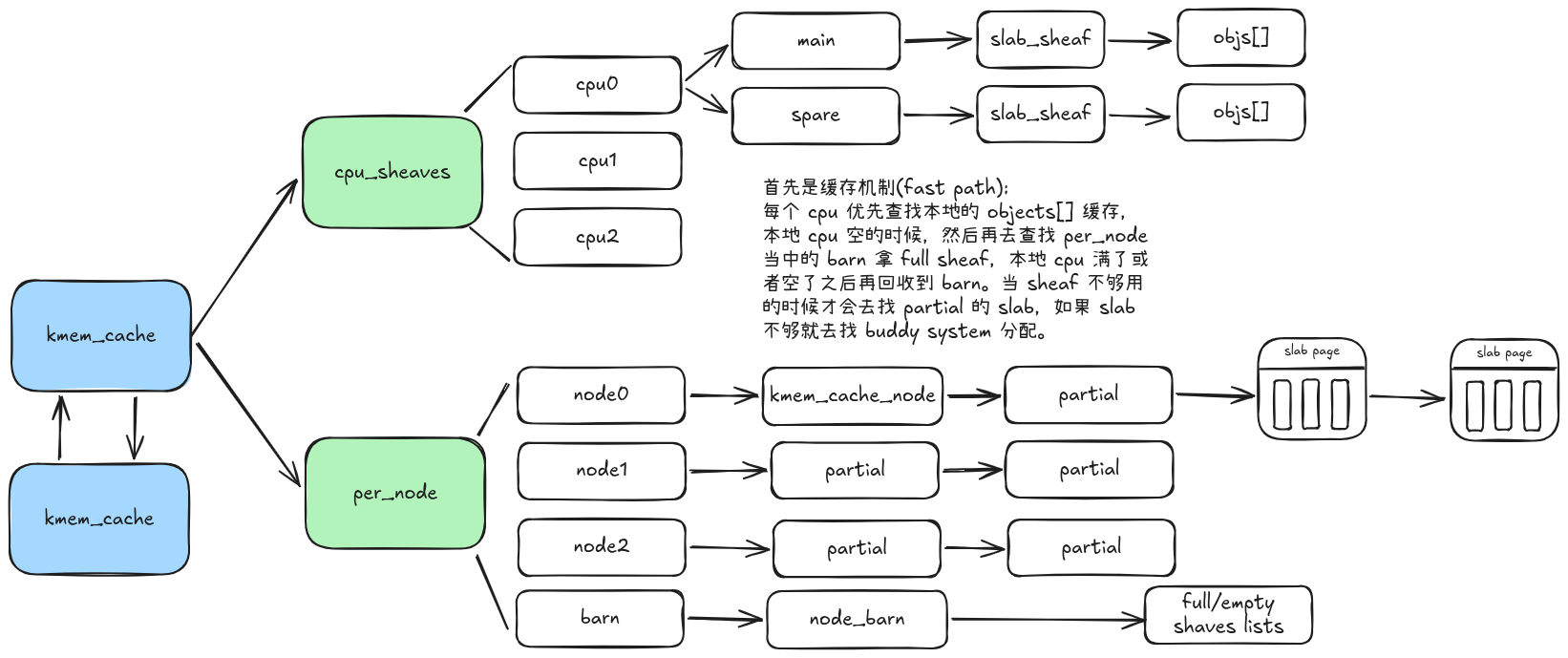
structslub_percpu_sheaves { local_trylock_t lock; structslab_sheaf *main;/* never NULL when unlocked */ structslab_sheaf *spare;/* empty or full, may be NULL */ structslab_sheaf *rcu_free;/* for batching kfree_rcu() */ };
structslab_sheaf { union { structrcu_headrcu_head; structlist_headbarn_list; /* only used for prefilled sheafs */ struct { unsignedint capacity; bool pfmemalloc; }; }; structkmem_cache *cache; unsignedint size; int node; /* only used for rcu_sheaf */ void *objects[]; };
staticunsignedint alloc_count = 3; module_param(alloc_count, uint, 0444); MODULE_PARM_DESC(alloc_count, "How many objects to allocate from the custom kmem_cache");
staticunsignedint kmalloc_request = 130; module_param(kmalloc_request, uint, 0444); MODULE_PARM_DESC(kmalloc_request, "Byte size used for the kmalloc bucket demo");
pr_info("slub_demo: sizeof(object)=%zu kmem_cache_size=%u\n", sizeof(struct slub_demo_obj), kmem_cache_size(demo_cache)); pr_info("slub_demo: ctor runs when SLUB prepares new objects, not on every alloc\n");
// 这里开始分配,分配 alloc_count 个 objects for (i = 0; i < alloc_count; i++) { demo_objs[i] = kmem_cache_alloc(demo_cache, GFP_KERNEL); if (!demo_objs[i]) return -ENOMEM;
demo_objs[i]->last_allocation_round = i + 1; dump_demo_obj("custom-cache alloc", demo_objs[i]); }
pr_info("slub_demo: ctor_calls after %u allocations = %d\n", alloc_count, atomic_read(&ctor_calls));
reused_obj->last_allocation_round = alloc_count + 1; dump_demo_obj("custom-cache re-allocation", reused_obj); if (freed_obj == reused_obj) pr_info("slub_demo: allocator returned the same address immediately after free\n"); else pr_info("slub_demo: allocator returned a different address; same-cache reuse can still occur later\n");
pr_info("slub_demo: ctor_calls after re-allocation = %d\n", atomic_read(&ctor_calls));
memset(kmalloc_buf, 0x23, kmalloc_request); pr_info("slub_demo: kmalloc request=%u actual_bucket=%zu ptr=%px\n", kmalloc_request, ksize(kmalloc_buf), kmalloc_buf); pr_info("slub_demo: for small requests, kmalloc is usually serving from a SLUB size cache rather than directly from buddy\n");